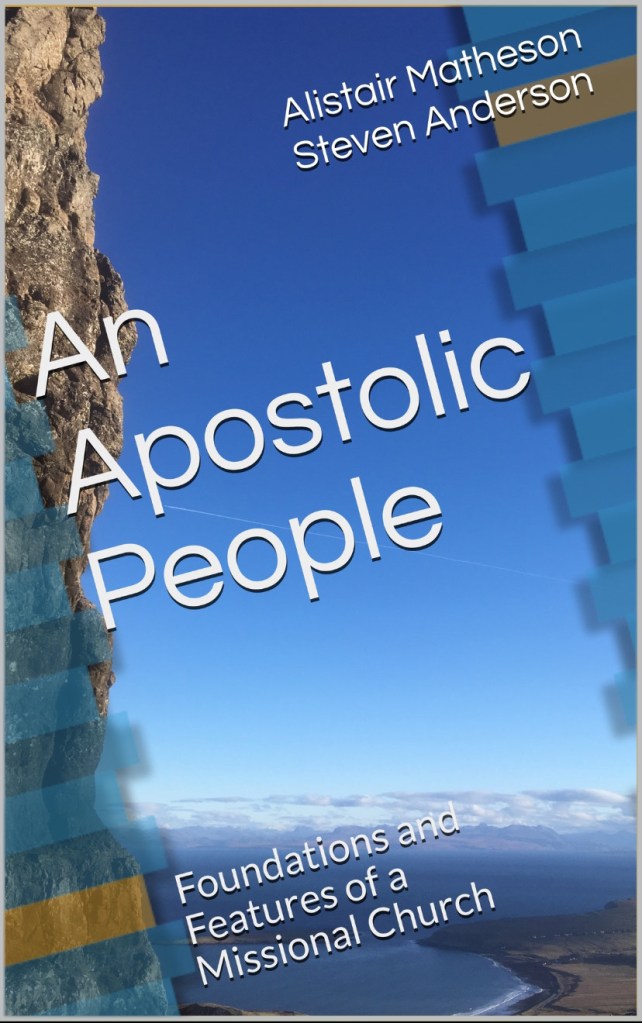
‘An Apostolic People: Foundations and Features of a Missional Church’ is the first book I’ve picked up in 2026, It’s a quick read. I started and finished on the 1st January. The book was a core text for the Baton course (a leadership development programme for ACUK). The course no longer runs, and has been replaced by ACTS Divinity, and therefore some aspects of the book (including links to audio messages) are redundant, however the basic content of the book is very much still relevant. This is a book about the church and for the church. Whilst it was written to teach ecclesiology (theology of the church) for those training for ministry in the Apostolic Church UK, it’s not exclusively a denominational book. It’s a book that’s relevant for Christians of any theological persuasion as it unpacks the DNA of what the New Testament church is called to be. Jesus loves the church, and if we love Jesus, we should love the church too. This is where the book begins — Christ’s love for his bride. Let me share some inspiring (and challenging) extracts from the book about what the Christian’s posture towards the church should be.
The book was co-produced by Alistair Matheson, senior pastor of Glasgow City Church, and Apostolic leader within ACUK and Steven Anderson, former Apostolic leader in ACUK and current founder of Map Makers, a simple church network. The following extracts, I think, are from one of Alistair’s chapters.
“I do not just believe in the church. I love the church. Why? Because I love Jesus. And loving Jesus, I find myself loving what Jesus loves. And He loves nothing more than the church. His church. The chosen people He died for and ever lives for. Warts, blemishes and all. Contradictions, offences, short-comings, hypocrisies, foibles and failings. Every reason some people have to walk away from church justifies the resolve of Christ to cleanse and purify, to mature and exhort, to build up and perfect. Let me be honest. I thank God for the times Jesus didn’t walk away from me. I am more grateful than I can express for the times He could have left my church too, but did not. That has proven to be one of the primary differences between Jesus and some Christians! I will never forget the time a loved and trusted friend walked up to me just as I was about to open a Sunday morning service, placed in my hand the keys of the facility where our church plant met, looked at me pitifully and blurted, “I’m leaving this church; it’s never going to grow.” I never saw him in our church again. But Jesus kept coming. And, despite what would have been a variety of other justifiable reasons to leave us too, Jesus just kept on coming back. He kept coming until we started to grow. I’ve moved on now, but they’re still growing. In fact, they’ve only gone and planted another church since I left. Jesus is still there. Still loving them, working with them, changing them. Still growing them. Is this not the nature of church? Church is more than a doctrine, glorious though that doctrine is. Church is the object of Christ’s undying, unstoppable love.”
“To love Jesus is to serve His people. If Jesus loves the church, so must I. When I share the cup of Communion, my covenant with Jesus extends to the community which is betrothed to Him. For better, for worse. For richer, for poorer. In sickness and in health – but never to be parted by death. I have never been fooled by those who say they love Christ but have no time for church. They do not love the real Jesus. They cannot know Him. They certainly do not follow Him. Jesus goes to church. He comes to my local church every time we meet. To use loftier, biblical language, the people of Christ are His place of abiding, the temple of His presence, ‘the dwelling of God in the Spirit’.”
“Because Christ is protective of His church, I am protective of it too. My own wonderful wife may not be perfect, but let no one speak disrespectfully or destructively of her in my presence! If they do, they should not be surprised if my defensive instincts are aroused! It is no different with the church. When people speak against church – any church where Christ is loved and His Gospel preached – I take it personally. It is something I take to heart, not merely a cerebral or philosophical matter. Every Christian should have this instinctive protectiveness for the church, not just their local expression, but the entire body of Christ. Paul emphasised to the Corinthians that when one part of the body suffers the whole body suffers with it. As the late Ern Baxter once quipped in poetic humour, “A pain in the head puts the whole body to bed!””
“I am always in some way diminished by the disappointments of other Christians, and always enlarged by their successes and victories, no matter who or where they are. It doesn’t matter how distant another Christian movement may seem to be, I am affected by its joys and sorrows. Whoever my brothers and sisters may be, I am of the same blood. Much though my Jesus loves me, He loves them no less. Disparage them and you disparage me. This is the nature of the church as one body.”
The book goes on to develop a solid yet introductory theology of what an apostolic church looks like. It’s saturated in scripture. The book is ideal for leadership teams, pastors, church planters or any Christian looking to think through biblical Christianity. As I said, the principles in this book are not exclusively denominational. They are universal principles that can be applied in a variety of denominational contexts. As one of the contributors (Tim Jack, former National leader of ACUK) writes in his chapter, Jesus is not just building the Apostolic Church, he’s building his body, and his body is made up of all true believers everywhere, no matter what label they gather under.
 Rev John James