The Ministry of W.A.C Rowe: (and a Tribute by Ian MacPherson)

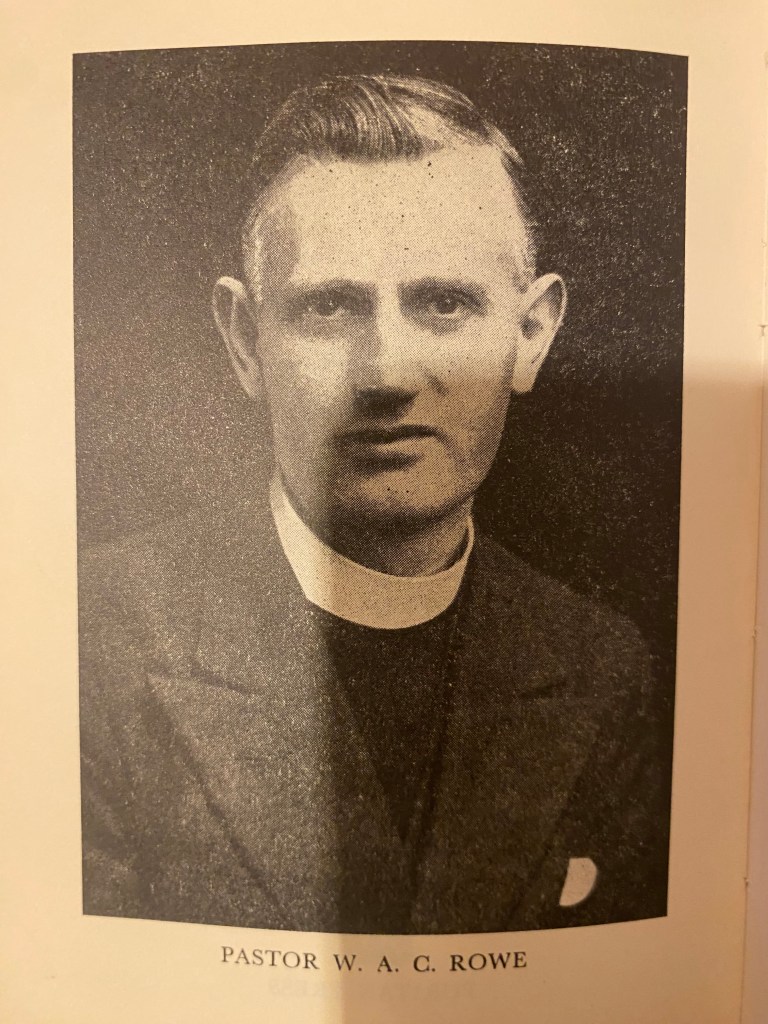
The following are extracts from a printed booklet that sampled sermons from the radio ministry of Pastor W. A. C. Rowe.

W.A.C Rowe was also the author of one of the first Pentecostal (and Apostolic) Systematic Theologies: One Lord; One Faith. Yet despite fondly dipping into this book many times over the years, I confess I knew next to nothing about this early Apostolic Pastor. That was until yesterday when this little book titled Skyway to the Heart made it’s way in to my hands.

Before I share a powerful extract from that booklet, here is a short bio and tribute to W.A.C. Rowe from another Apostolic Church legend, Pastor Ian McPherson who wrote the foreword.

” Billy” Rowe, as he was affectionately known by those who were intimate with him, is in my mind always associated somehow with another ” Billy”-Billy Graham.

Those of us who remember Pastor Rowe as he was in youth —a tall, handsome, striking figure-were irresistibly reminded of him on first seeing the famous American evangelist.
Nor was the likeness merely physical: it was moral too.

About Pastor Rowe there was the same dignity and nobility, the same poise and personal charm, the same radiant Christ-likeness.

Like Billy Graham, moreover, Pastor Rowe was a great master of the spoken word. He had the skill of a barrister in the cut and thrust of debate and could sway a council or conference by the cogency of his reasoning and by the persuasive manner in which he could present his case. He really loved people and was never happier than when in the midst of them. This gave him keen insights into human character and accounted to some extent for the extraordinary power he wielded over others.

But the resemblance between him and the great evangelist did not end even here. It was most marked in their being outstanding preachers.
I have reason to believe that Pastor
Rowe regarded himself as, first and foremost, an administrator. But I feel sure that, exceptional as were his qualifications in that sphere, it was as a preacher that he excelled.

Many of the addresses which he delivered at great conventions and conferences in Great Britain, Australia, New Zealand, South Africa and America as well as on the Continent of Europe will live on in the memories of those who heard them as long as life lasts. Every preacher, I suppose, has his favourite themes, and perhaps the subject on which Pastor Rowe delighted most of all to dwell was “The Glory of Christ.” His ministry was, however, rich and many-sided, and I have seen him often busy during leisure hours on a book which was to have been a systematic exposition of the whole field of Christian doctrine.

(Incidentally, I do hope that that book will be given to the world, for I am certain that into the making of it he poured the best and ripest of his thought).
To return to his preaching : the finest message I ever heard him give was on “Naboth’s Vineyard.” What a masterly discourse it was and how tellingly and compellingly it was applied !

Among all his work for the pulpit none gave him greater pleasure and for none did he prepare with such meticulous care than the talks which he gave Sunday after Sunday over the air in Melbourne. By means of this radio ministry he reached a very wide constituency and many letters came in expressing appreciation of the thrilling messages or asking for prayer or personal visitation.

I have myself been present with him when he sat in front of the microphone in the radio-station and I can testify that when the red light went on intimating that the apparatus was alive he did not merely talk at the microphone, he poured himself through it. As well as any broadcaster I have heard, he succeeded, not only in putting his message over, but in projecting his personality, as it were, through the mechanism.

It is no wonder the hearers were blessed. The addresses to which they listened were vital and vibrant with the very heart’s blood of the man who delivered them.

In this little book are published for the first time some of these inspired addresses. We miss the man behind them, for cold print can never convey an adequate impression of the impact made by the living word. Yet no-one can write with burning sincerity and passionate conviction without imparting even to his printed message something of the dynamic quality of personal communication. Of this these broadcast sermons provided convincing proof. About them there is that lightness of touch, elegance of expression and warm brotherliness of approach which all those who knew Pastor Rowe would expect from him. With all my heart I commend them. I know that they were penned in the atmosphere of prayer and that the breath of God blows through them.

Nobody who reads them can fail to be enlightened and enriched.

By his tireless labours and by study, ministry and the personal superintendence of a large group of churches throughout the Commonwealth of Australia, Pastor Rowe literally wore himself out. His labours took a terrible toll of his life. The end came suddenly. A sharp pain at the heart and in an hour or two he was gone. On his dying lips was a sentence which he had been in the habit of repeating and which indeed might well be taken as an epitome of the message of his whole life: “Jesus is a wonderful Saviour!” Looking back on the many happy associations I had with him, I recall particularly the day on which he and I together visited Dr. F. W. Boreham, the famous Australian essayist, in the latter’s bungalow in one of the beautiful suburbs of Melbourne. Dr. Boreham received us most graciously and we sat for some time chatting with him about matters of mutual interest. Then, as we rose to go, Dr. Boreham, a saintly old gentleman of more than eighty years of age, asked us if we would accept his blessing. We gladly consented.

Together in a small circle we stood in his lounge and, laying a hand on the head of each of us, Dr. Boreham prayed most fervently that God would visit us, and in the lovely language of the Aaronic blessing pronounced a benediction upon us.
Somehow I feel that that benediction breathes through these pages and I am sure that you too will feel it as you read them.

IAN MACPHERSON.

What a powerful tribute and insight into a man of God from previous generations.

Now here is a snap shot of his own writings. This one is on the theme of the love of God.

Incomparable Love
… I have loved thee with an everlasting love .
Jeremiah 31: 3.

THE great French evangelical minister, Monod, when dying was asked how he felt. He replied, ” I have strength for nothing more than to think about the Love of God: He has loved us… that is the “All in all’ of divine dogmatics. Let us love Him, that is the ” All in all’ of human ethics.” Truly, a short, but incisive summation of the greatest truth and experience in life.
I was musing, with very much sweetness, on the same theme, the divine declaration in the Old Testament, ” I have loved thee with an everlasting love.” My mind leapt to the New Testament handmaid to that verse, ” That ye … may be able to comprehend… the breadth, and length, and depth, and height; and to know the love of Christ which passeth knowledge.” What amazing love! What immense spiritual dimensions !

THE LOVE OF GOD IS DEEPER THAN THE DEEPEST HELL.

We can imagine nothing lower than that.
It is this exercise of divine love that manifests the passion to redeem. Jesus Christ, the Son of God, tasted death for every man, both the first and the second deaths. He drank the totality of the cup of hell’s everlasting sufferings. In order to be the Saviour of the world, Christ went down underneath all the worst cases. Jesus descended into hell and gathered up the souls of the righteous and bore them up into Paradise. With the keys in the Master’s possession it bespeaks His complete dominance of the lowest hell. From God’s love comes the power to deliver. ” Jesus breaks every fetter.” He smashes the powers of evil. He destroys the Destroyer’s bondage. Whom the Son makes free is free indeed. 

Have we become eschatologically agnostic? (Does what we believe about the End Times matter?)

The Apostolic Church, like most denominations, has a statement of faith.

In our statement of faith we have a section that reads, we believe in:

“The virgin birth, sinless life, atoning death, triumphant resurrection, ascension, and abiding intercession of our Lord Jesus Christ; His second coming, and millennial reign upon earth.”

That’s a lot of Christology, soteriology, and eschatology squeezed into one small paragraph!

There’s one aspect I’d like to draw attention to.

“His second coming, and millennial reign upon earth.”

ACUK, like the other mainstream Pentecostal denominations, (and all mainstream denominations) has reference to the second coming of the Lord Jesus Christ. Unlike AoG and Elim, ACUK specifically mention “the millennial reign.”

However, it doesn’t mention what it means by this. Arguably all eschatological views believe in the millennial reign, but all understand it differently. Some see it symbolically, some see it literally.

In order to understand how ACUK and indeed other Pentecostal denominations understood the millennial reign, we need to understand their history.

Whilst most denominations have moved on from the time periods when their creeds were first formed, it is their history that helps us understand how their creeds were meant to be understood.

The Pentecostal churches, much like the Brethren churches were premillenialist. So when the ACUK tenets speak of “the millennial reign” the assumption was that this was understood in a premillenialist (and a dispensationalist) sense.

We only need to look to the denomination’s early systematic theology to see this.

W.A.C. Rowe’s ‘One Lord, One Faith’ shows us the early ACUK position on the second coming.

“We take one further step and assert that the Second Advent is PRE-MILLENNIAL. There is widespread belief amongst nominal Christians that, under the influence of religious teaching, Christendom will be extended gradually until the whole world comes under the sway of God. And that then, in the far dim and distant future. in some unpredictable and nebulous manner Christ will come and take control. In other words, man is going to get better and better until the crowning day. This is but a development of the teaching of evolution, which the Bible does not countenance. To the contrary, the Word clearly tells us that the world will get worse and worse (II Timothy 3: 1-5). Indeed, the Lord asks concerning Himself and His coming,
“Nevertheless when the Son of man cometh, shall He find faith on the earth?” (Luke 18: 8). However, the Scriptures do give a magnificent outline of a period of peace, prosperity and Godliness that shall envelop the whole earth, when Satan shall be chained (Revelation 20: 1-2): a time when ” the earth shall be full of the knowledge of the Lord, as the waters cover the sea” (Isaiah 11: 9).

The length of this time, during which Christ reigns over all the world is a thousand years (Revelation 20: 2-6) and is termed the ” Millennium.” While we do not believe in date-fixing for the Second Advent (Matthew 24: 36) we are sure that the order of events is made plain and that the signs of the times already predicted do narrow down and define a focal period of inspired expectation.
Divine intervention is imperative; the forces of mass destruction are balanced precariously; international leaders are breathless in apprehension.
The world has largely forgotten God and the
realities of spiritual life and worship.
They are chasing an elusive
“will-o’-the-wisp” of selfish satisfaction in seeking material prosperity, worldly pleasures, pomp and power. Into this condition of affairs the Lord Jesus Christ will appear in power and glory (Revelation
19: 11-16) to set up His earthly Kingdom.

The Second Coming is also TRANSITIONAL. This grand happening is the bridge which links two great periods-the Dispensation of Grace and of the Kingdom. During this brief span, and connected with the Advent itself in this transition period, there are a number of occurrences. There is ceaseless activity in heaven and on earth. In the former there is the preparation for and the full manifestation of Christ: on the latter Satan moves in the hearts of men and the “world-system” to the consummation of evil.

Concurrently there is an “apocalypse” of Christ and His glory and of the Devil and his wickedness, with the ultimate overwhelming glory and victory of the Son of Man in a blazing triumph (Jude 14, 15). The whole time of Advent activity includes the royal assemblage and translation of the saints (I Thessalonians 4: 14-17); the judgment seat of Christ (II Corinthians 5: 10); the battle of Armageddon (Revelation 16: 16); the Marriage Supper of the Lamb (Revelation 19: 9); the judgment of the living nations (Matthew 25: 32); the setting up of the Throne of David and re-establishment of Israel in the fulness of divine promise (Isaiah 9: 7). It appears that the whole movement of the Second Coming progresses in precise and orderly stages. Our Lord’s appearing falls into two main divisions the first, secret: the second, public. The redeemed are caught up to meet Him in the air in secret rapture (1 Thessalonians While later the Lord will again come right down to the
earth with His saints in public revelation (I Thessalonians 3 : 13).

Therefore, we can state that the coming is REGAL. Listen to the clarion note of the prophet,
“And the Lord shall be king over all
the earth: in that day shall there be one Lord and His name one” (Zechariah 14: 9). Furthermore,
“He hath on His vesture and
on His thigh a name written KING OF KINGS
3, AND LORD UP
LORDS” (Revelation 19: 16). With Antichrist and his armies defeated and Satan bound, Christ will reign over all the earth in regal splendour. The once despised Christ, sorrowing and rejected (Isaiah 53: 3) now unleashes the brilliance of His eternal majesty, which far exceeds the radiance of the Mount of Transfiguration (Mark 9: 2-3), or the effulgence seen on the Damascene road (Acts behold His glory (John 17: 24) and to be seated with Him on the Throne (Revelation 20: 4).

To conclude, the second Advent will be JUDICIAL. Let there be no mistake, despite the apparently contrary appearances, the day of justice and judgment is approaching (Acts 17: 31). There are a number of judgments.


Three of these are outstanding: the great
white throne judgment of Revelation 20: 11-15 and which relates to the unbelieving dead and to an occasion after the Millennium; the judgment seat for believers and the judgment of the nations then living.
Obviously, the two latter are swept into our subject.

The nations at the time of the Lord’s return to earth will be judged pre-eminently according to their attitude and conduct towards the Jews.


They have endured centuries of suffering and torture, which in the last analysis, has been their penalty for the rejection and crucifixion of the Messiah.

Yet, God will not hold the oppressors
guiltless (see Revelation 19: 17-21). Following the secret rapture in the air, and in heaven before Christ’s return, the redeemed “…
Must all appear before the judgment seat of Christ…
” Here it is not our standing in Christ that is in question; but our state: not our salvation; but our service; not our destiny; but our deeds.
In view of the judicial character of the Second Advent saints have the great incentive of not only loving the Lord (I Thessalonians 1: and and longing for His coming (I Thessalonians 1: 10); but to prepare themselves by yielding to the work of the Great Refiner (Malachi 3: 3) so that they may meet their Lord with joy and not with shame.
With this hope burning in our hearts, let us fulfil the exhortation
“Look up… for your redemption draweth nigh” (Luke 21: 28).”

The reality is, in contrast to the early stages of our churches’ development, today we are mostly functional eschatological agnostics. The old cliche about being a “pan millennialist” (yes I’ve said it too) is perhaps a deflection tactic to avoid the hard work of thinking Biblically about a subject that can be controversial, sensationalist and confusing!

None the less, we are called to rightly divide the Word of Truth. Not least because of the times we are living in.

What we think about the End Times matters. The Apostles thought so. The OT prophets thought so. And the early founders of our denominations thought so. Maybe they knew something we have have over looked?

Cardinal Newman: The Church is like an Equestrian Statue

Following on from my “old books; Fresh Truths’ post and my quote from David Watson’s book Discipleship, I thought I’d share another extract, this time David is drawing from an image of the church spoken by Cardinal Newman.

Cardinal Newman once said that the church is like an equestrian statue: the front legs are lifted up ready to leap forward, every muscle of the back legs is standing out and throbbing with life. As you look at the statue you expect it to spring forward at any moment. Unfortunately, when you come back twenty years later, it has not moved a fraction of an inch. Yet look at the early church twenty years after the outpouring of the Spirit; they had moved forward by astonishing leaps and bounds. There was one simple reason: the power of the Spirit was with them.

How can we know this inward power? The answer, said Jesus, is that we must ask our heavenly Father for it. ‘If you then, who are evil, know how to give good gifts to your children, how much more will the heavenly Father give the Holy Spirit to those who ask him!’

Can Old Books Give Us Fresh Truths? (David Watson warns about the danger of spiritual asthma)

I love a new book as much as the next person. We need fresh perspectives on today’s issues. That said, I love old books more. Older books have a way of speaking into contemporary situations without the presuppositions of contemporary authors (and readers). That’s not to say authors from previous generations don’t have their own presuppositions (every one does) it just means they perhaps don’t share the same blind spots as us. Consequently, they may actually be able to help us see our own blind spots.

Over the next few months, I’m planning to dip into some old books in order to share some fresh truths. The first one is from the late David Watson. For those who may not know, David Watson was the vicar of St. Michael le Belfrey York; he was a key player in the Charismatic Renewal movement within the Anglican Church during the 1960s-80s; he was also a highly respected international evangelist. For more on David Watson, check out Tom Marshall’s piece on him here.

Here is today’s fresh truth from an old book. In David’s classic book Discipleship he warns of the dangers of spiritual asthma.

For about sixteen years I have suffered from asthma. Fellow-sufferers will know what a crippling condition this can be. When you are gasping for breath you are literally fighting for life. You cannot talk, walk, work or do anything.

The church in many parts of the world today is in a chronic asthmatic condition. A century ago, Edwin Hatch wrote the hymn:

Breathe on me, Breath of God, Fill me with life anew;
That I may love what Thou dost love And do what Thou wouldst do.

That is a prayer we need to pray with all our heart today: that the breath of God’s Spirit might bring new life to the whole church and to every Christian.

David Watson, Discipleship, 1981, p94. 

David’s book Discipleship is available here, I highly recommend it.

When was the last time we were overwhelmed by God’s love for us?

I was recently at a church prayer meeting and a brother in the Lord was sharing about how he had been reflecting on God’s faithfulness to him, even amidst various forms of trials he had gone through. As he recounted God’s goodness, he gently broke down in tears. It was a powerful moment.

It got me thinking: when was the last time I was deeply moved to tears over the reality of God’s love or faithfulness?

The person went on to share a well known and popular worship song:

I love You, Lord
Oh, Your mercy never failed me
And all my days, I’ve been held in Your hands
From the moment that I wake up
Until I lay my head
Oh, I will sing of the goodness of God

All my life You have been faithful
All my life You have been so, so good
With every breath that I am able
Oh, I will sing of the goodness of God

I love Your voice
You have led me through the fire
In darkest night You are close like no other
I’ve known You as a Father
I’ve known You as a Friend
Oh, I have lived in the goodness of God, oh-oh-oh

And all my life You have been faithful
All my life You have been so, so good
With every breath that I am able
Oh, I will sing of the goodness of God

I think I can remember one of the last times I was moved to tears, and funnily enough it was whilst that song was playing in the car as I drove home from Linwood to Perthshire following the death of my grandmother. I had just spent a week or so helping to care for her as she spent her last days battling cancer in her own home. I had an opportunity to be present with her, pray with her, read scripture to her and to lead her in a prayer of repentance and faith in Christ just before she died. As I drove home, the faithfulness of God was a tangible reality.

As I write this, I’m reminded of a prayer that Paul wrote for all Christians at all times:

I pray that you, being rooted and established in love, 18 may have power, together with all the Lord’s holy people, to grasp how wide and long and high and deep is the love of Christ, 19 and to know this love that surpasses knowledge—that you may be filled to the measure of all the fullness of God. (Eph. 3:17–19)

I’ve read these words countless times, maybe you have too, but tonight they are stopping me in my tracks.

What would it feel like if this prayer was answered in my life, right now? What would it look like in your life, if God answered this prayer, even a tiny bit?

Would we fall down face first, overwhelmed by the sheer intensity of the revelation? Would we burst out in praise?

As I meditate on this, I’m reminded of another song, and whilst it’s speaking of seeing Jesus face to face when we go to be with the Lord, I think the principle is also true when we reflect on Paul’s prayer. If Paul’s prayer were to become a deeper reality in our life, how would we respond? One thing I’m certain of, it couldn’t be a stoic indifference.

The Song I’m thinking of says:

I can only imagine
What it will be like
When I walk by Your side
I can only imagine
What my eyes would see
When Your face is before me
I can only imagine
Yeah

Surrounded by Your glory
What will my heart feel?
Will I dance for You Jesus
Or in awe of You be still?
Will I stand in Your presence
Or to my knees, will I fall?
Will I sing hallelujah?
Will I be able to speak at all?
I can only imagine

There is perhaps only one part of the song I don’t agree with — and it’s the title and tag line “I can only imagine”. I don’t think that’s true. I think we can actually know. And the reason we can know is because it is possible to have a foretaste of heaven here on earth. How we respond to the revelation of God’s love and presence on earth, is an indication of how we will respond in eternity.

Am I really on my way to heaven, if I’m completely unmoved by God’s love and grace here on earth? Will I really taste the eternal joy of glory, if I’m too overwhelmed by the cares of this world or the desire for other things? (Mark 4) According to Saint Peter, it is possible for us to know the eternal joy of the Lord even now:

Though you have not seen him, you love him. Though you do not now see him, you believe in him and rejoice with joy that is inexpressible and filled with glory, (1 Peter 1:8)

Lord, forgive me for where I’ve become indifferent to your grace and love. Let me never lose sight of the wonder of salvation. Lord, relight the fire of first love deep in my spirit, in Jesus’ name.

Again, as I type these words, another song comes to mind, this time from Keith Green:

Oh Lord, you’re beautiful,
Your face is all I seek,
For when your eyes are on this child,
Your grace abounds to me.

Oh Lord, please light the fire,
That once burned bright and clear.
Replace the lamp of my first love,
That burns with Holy fear.

I want to take your word and shine it all around.
But first help me to just, live it Lord.
And when I’m doing well, help me to never seek a crown.
For my reward is giving glory to you.

Oh Lord, you’re beautiful,
Your face is all I seek,
For when your eyes are on this child,
Your grace abounds to me.

I want to take your word and shine it all around.
But first help me to just, live it Lord.
And when I’m doing well, help me to never seek a crown.
For my reward is giving glory to you.

Where are the Preachers of the Word? A Challenge from two Church of Scotland Ministers to the Church in Scotland

This week I have come across two quotes, from two Church of Scotland Ministers (one living and one deceased) which are remarkably similar in spirit, despite being written more than 40 years apart. One is challenging the quality of preaching in contemporary ‘evangelicalism’ (a defining term that doesn’t really say much about anything anymore) and the other was challenging the influence of relativism upon mainstream Church of Scotland Ministers.

On his social media account, Rev Kenny Borthwick posted the following challenge:

How come so many Christian leaders sound like motivational speakers, more like well heeled gurus from the world of business or sport? No mention of Jesus or Scripture: these are replaced by worldly thinking, a mixture of positive thinking mixed with amateurish psychology, to get you to the sweet spot of becoming an influencer, well boundaried for your own protection. It’s a far cry from the Jesus of cross. Influence and safety are not the sweet spot for a believer. They are modern day secular idols creeping into the church, the opposite of the Jesus way. The Jesus way is not safe. its aim is not to have calculated and engineered friendships or envy creating influence at any cost. Do you need to pull some very enticing idols down?

Kenny is burning a mountain of sacred cows in this post. He is challenging ministry ambition, ministry motivation, and ministry content. Further he is naming this pursuit of relevance the way the Bible does: Idolatry.

What strikes me is how similar the problems are in contemporary evangelicalism to the problems that emerged in the mainstream established churches. Liberalism.

This is quite a striking comparison, because it’s perhaps not obvious to see contemporary ‘lively’ churches as having anything in common with the old mainline denominations. Yet the following quote from the Late Rev William Still is tackling a similar issue to that which is raised by Kenny Borthwick.

William Still wrote:

If the present climate of theological opinion and biblical scholarship is to prevail, we fear that it is going to take many so long to determine what they do believe and what they do not, that this generation may have passed into the Hell about which the modern church is so uncertain, before they can make up their minds. It is the problem of this, the problem of that – all problems, no solutions; all fog and darkness, no light! And, in any case, where is the apostolic conviction to come from in a Gospel of shreds and patches? It is the surrender of the will to intellectual conviction of the Truth which alone inflames men’s hearts and sets them on fire for God. The Gospel will never again run through Scotland and ‘set the heather on fire’ until the men of the Church of Scotland sacrifice their pride of intellect and fall humbly before Him whose Word is too great for us to ever fully understand, and then rise to proclaim simply like faithful errand boys. Heralds do not need great intellects (indeed too much may mar their service!). The defence of God’s Word is with God He will look after that! The proclamation of it is with us, and woe betide us if we fail! For if we do, God will find himself a living Church elsewhere, and by it He will work, and will by-pass us to our everlasting shame! ‘All scripture is God breathed’ says Paul to Timothy, ‘and is profitable.’ No Christian needs more than this to make him an authoritative herald of God’s word. . . May God grant us all to be so convinced, cleansed and inspired by His Word ourselves, that we proclaim it with convicting and converting power, to his glory, not ours.

Both quotes expose a Christless and Bible-less pulpit for what it is: compromise with the world. The contexts may be different, Still was challenging a church that was desperate for academic validation. The academic world at that time was anti-supernaturalist. The ghost of modernism was alive and well. Kenny is challenging those who are looking for validation from the internet. Whether the preacher replaces Christ and scripture with academic ambiguity, or the motivational pop-psychology of the social media influencer, the problems are the same: wrong motivations, wrong methods and ultimately the wrong results.

God has only ordained one method, one motivation and one source for ministry success and that is the preaching of the cross for the glory of God in the power of the Spirit.

Paul puts it this way:

And so it was with me, brothers and sisters. When I came to you, I did not come with eloquence or human wisdom as I proclaimed to you the testimony about God.[a] For I resolved to know nothing while I was with you except Jesus Christ and him crucified. I came to you in weakness with great fear and trembling. My message and my preaching were not with wise and persuasive words, but with a demonstration of the Spirit’s power, so that your faith might not rest on human wisdom, but on God’s power.

1 Cor. 2:1-5

What happens when we lose confidence in God’s Word?

If we are not building our lives on the foundation of God’s Word, then something else will take its place.

Pastor Colin Dye says:

“Once confidence in the Word of God is lost, then the bedrock of revelation is removed. This means all that’s left to build upon are the sinking sands of human opinion.”

Colin Dye, Hearts on Fire: Walking in Personal Revival p105, (Dovewell, London, 2002).

It’s true. Without the external revelation of the Word of God, all we are left with is the subjective and shifting ground of human opinion. Postmodern relativistic thinking has shaped our culture to the point where many pastors and leaders have a crisis of confidence. Many are reluctant to speak with any degree of certainty about anything other than increasingly typical moralistic mantras of the day. At that point the inconsistency of relativism becomes apparent. It’s not really a rejection of absolute truth claims, it’s just a rejection of what is regarded to be socially unacceptable truth claims. Again, the problem with all of this is the simple reality that human opinion and preference is exalted above the plain teaching of scripture.

Does what we believe about the Bible really matter?

The Bible is (probably) read in every church. It’s (probably) read by almost every professing Christian (some will read it more than others). Most Christians (probably) have some idea of some of the things the Bible says. Yet how many Christians think biblically about the Bible?

What do I mean?

The Apostle Paul gives us a clear definition of what scripture (The Bible) is:

“All Scripture is God-breathed and is useful for teaching, rebuking, correcting and training in righteousness, so that the servant of God may be thoroughly equipped for every good work.” 2 Tim 3:16-17

Notice the word “All”. This is a really important word. Paul does not say, “some”, “most” or “the majority” of scripture is “God-breathed” he says “all scripture is God breathed.” This is why most churches have a clear statement about the doctrine of scripture in their statement of Faith.

Elim for example states:

We believe the Bible, as originally given, to be without error, the fully inspired and infallible Word of God and the supreme and final authority in all matters of faith and conduct.

The Apostolic Church states:

The voice of Scripture is the voice of God. The whole Bible is the inspired Word of God, infallible in its declarations, final in its authority, all-sufficient in its provision, and comprehensive in its sufficiency. 

The Westminster Confession of Faith states:

The Supreme Judge, by which all controversies of religion are to be determined, and all decrees of councils, opinions of ancient writers, doctrines of men, and private spirits, are to be examined, and in whose sentence we are to rest, can be no other but the Holy Spirit speaking in the Scripture.

The Evangelical Alliance Basis of Faith says, regarding the Bible the Alliance believes in:

The divine inspiration and supreme authority of the Old and New Testament Scriptures, which are the written Word of God – fully trustworthy for faith and conduct.

All of these statements, in their own unique way, demonstrate a classic, orthodox view of the Word of God. These are not the sentiments of some fringe, fundamentalist sect. This is the mainstream view of the church catholic, down through the ages.

Why does this matter? The belief that the the Bible is the Word of God, is not just an ecclesiastical issue, it’s a discipleship issue. I’d also go so far to say it’s a salvation issue. Throughout the Old and New Testaments, there is a direct link between people’s posture towards God’s word, and their spiritual condition. Those who receive the Word of God in a reverent spirit are blessed, those who reject it encounter God’s judgement.

The Book of Proverbs reminds us:

My son, do not forget my teaching,
    but keep my commands in your heart,
 for they will prolong your life many years
    and bring you peace and prosperity.

Prov 3:1-2

The longer we are in church, the longer we are in the world. and the longer we are exposed to theology or various Bible teachers, the more chance we have of forgetting the Lord’s teaching and allowing his teaching to drift from our heart. Confidence in the living Word of God is not simply an intellectual belief, it’s a heart posture.

Psalm 1 reminds us of the blessings of allowing the Word of God to have central place in our lives:

Psalm 1

Blessed is the one
    who does not walk in step with the wicked
or stand in the way that sinners take
    or sit in the company of mockers,
but whose delight is in the law of the Lord,
    and who meditates on his law day and night.
That person is like a tree planted by streams of water,
    which yields its fruit in season
and whose leaf does not wither—
    whatever they do prospers.

Not so the wicked!
    They are like chaff
    that the wind blows away.
Therefore the wicked will not stand in the judgment,
    nor sinners in the assembly of the righteous.

For the Lord watches over the way of the righteous,
    but the way of the wicked leads to destruction.

Let me encourage you, in these days of fake news, information overload, and truth wars, let the Word of God be your guide. Open the scriptures, read the scriptures, and study the scriptures. Allow the Spirit of truth to kindle a love and an understanding of God’s Word in your heart. In these days we need discernment more than ever because spiritual deception is a real danger. God’s Word is the key to overcoming in these days. God’s Word builds faith, and sharpens our spiritual perception, when we read it with a humble heart that is willing to obey the truth we discover in the pages of the book.

Transitions: Ministry Update re Kairos Church

On Sunday the 22nd February, I preached my last sermon at Kairos Church as the Lead pastor, having planted the church in 2020. It was a very moving service with a variety of emotions. There was a natural sadness that comes with the end of a season, but there was also joy and gratitude in seeing the church growing into an established congregation.

There are a number of providences that have brought us to this juncture, and I’ll paste the update I shared on social media below. To sum it up here though, a comment made by Rev Kenny Borthwick last summer on Lewis, when we met for breakfast, captures it well: ‘It’s not the end of ministry, it’s a clarification of ministry.’ For the last five years, I’ve been church planting, leading evangelism teams and street outreaches, doing itinerate ministry, pastoring, conducting funerals alongside full time prison chaplaincy. This is without even mentioning family, my wife’s full time work at Street Connect, and a number of family health issues. All this to say, the situation was unsustainable.

‘It’s not the end of ministry, it’s a clarification of ministry.’ Rev Kenny Borthwick

This is not to say anything has been short circuited. It’s not. There was a grace upon us for the work we were carrying. Part of the process of discernment is recognising when the grace is lifting because the season is changing.

On Sunday I preached into the season on the subject of Becoming an Antioch Church. I also shared some of the personal circumstances that have led up to to this decision.

Through it all, we know that God is faithful and that his purposes will come to pass. The season is not without it’s difficulties, but it is also not without its joy and blessings.

Here is the statement that I posted on my personal Facebook Accounts following the announcement at the church. I thought it good to share it here on my blog, as I hope to be able to devote time to writing again. Reading and writing is a passion of mine, and during the last few years there just hasn’t been time. By God’s grace, I hope to be able to able to find time to read and write more consistently.

Transition Statement shared 24/02/2026

It is with a mixture of joy and sadness I write the following ministry update regarding Kairos Church.
Following a series of ongoing, and serious family health complications, alongside full time work/ministries Laura, myself, and the ACUK National Leadership team have discerned that the time has come for me to step back as lead pastor of Kairos Church.

I am however delighted to announce that Ps Alistair Matheson will step into the role of lead pastor on an interim basis for the next 1-2 years with the specific objectives (along with Ps Tom Workman) of developing the local leadership team and identifying a longer term lead pastor.


I will focus my energies primarily as a full time prison chaplain but in due course I will also be ordained as an ACUK Evangelist.
I will God-willing, continue to support Kairos, and other churches with preaching and evangelism equipping and outreaches. However, my main focus will be supporting my family and wife as we navigate health challenges.


Regarding the health challenges, Laura’s vision and mobility has suffered deterioration in recent months. (Laura’s sight has been damaged through Retinal vein occlusion (RVO), and hyper tension, both of which is resulting in treatment but which has also halted much needed surgery. Her mobility has deteriorated to the point where she cannot move about the home without crutches.


Throughout this season we are grateful to the the Lord for his strength and Alistair, Tom, and other pastors, along with the ministry team who have invested in supporting the church. Alistair is a widely respected national leader. I know, by God’s grace, under his leadership, the church will not only survive, but it will thrive.

I’m also deeply grateful to friends of Kairos from various parts of Scotland, UK, and indeed the world who have supported this work either financially, or through ministry, encouragement, or prayer. I am indebted to many Christians and leaders both in the ACUK and beyond who have stood with us and invested in this church when it was a barely formed vision. There are too many people to name individually, but I thank you for supporting us and helping the church get to where it is today. May God bless you richly.


So let me finish by saying thank you to Kairos Church for allowing me to serve you as your pastor, thank you for letting me preach the gospel to you, and thank you for your patience with my faults and mistakes – I’m sure there are many I’m not even aware of. And thank you for loving Jesus, loving his people and serving the Lord through this local expression of the church we call Kairos (a key or critical time in God’s purposes).


As a church, this is another Kairos moment, and we can say with confidence: “And who knows but that you have come to your royal position for such a time as this?” Esther 4:14


We also know that what God births, he sustains: “being confident of this, that he who began a good work in you will carry it on to completion until the day of Christ Jesus.” Phil. 1:6

Jesus has promised to build his church, and he has promised that the gates of hell shall not prevail against it. I look forward to continued partnership in the gospel, as we navigate this new season, knowing that God is faithful.
Yours in Christ,
Ps John Caldwell
If you want to hear my last message as lead pastor and update to church you can find it here: (Along with a very powerful testimony from Laura).

“I love Jesus but I don’t need the church!”: Is this Biblical?

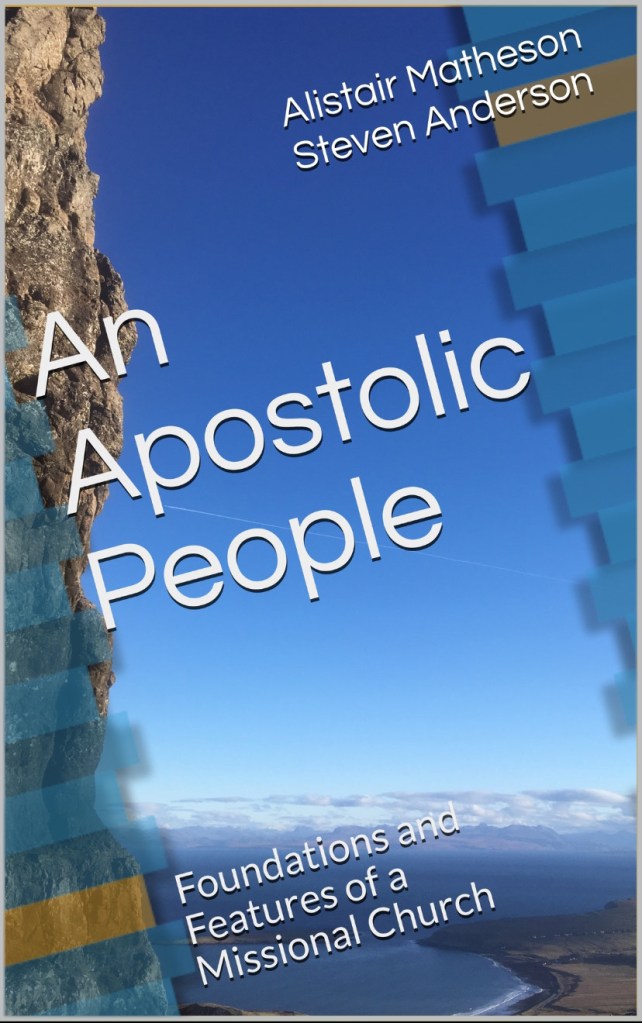
‘An Apostolic People: Foundations and Features of a Missional Church’ is the first book I’ve picked up in 2026, It’s a quick read. I started and finished on the 1st January. The book was a core text for the Baton course (a leadership development programme for ACUK). The course no longer runs, and has been replaced by ACTS Divinity, and therefore some aspects of the book (including links to audio messages) are redundant, however the basic content of the book is very much still relevant. This is a book about the church and for the church. Whilst it was written to teach ecclesiology (theology of the church) for those training for ministry in the Apostolic Church UK, it’s not exclusively a denominational book. It’s a book that’s relevant for Christians of any theological persuasion as it unpacks the DNA of what the New Testament church is called to be. Jesus loves the church, and if we love Jesus, we should love the church too. This is where the book begins — Christ’s love for his bride. Let me share some inspiring (and challenging) extracts from the book about what the Christian’s posture towards the church should be.

The book was co-produced by Alistair Matheson, senior pastor of Glasgow City Church, and Apostolic leader within ACUK and Steven Anderson, former Apostolic leader in ACUK and current founder of Map Makers, a simple church network. The following extracts, I think, are from one of Alistair’s chapters.

“I do not just believe in the church. I love the church. Why? Because I love Jesus. And loving Jesus, I find myself loving what Jesus loves. And He loves nothing more than the church. His church. The chosen people He died for and ever lives for. Warts, blemishes and all. Contradictions, offences, short-comings, hypocrisies, foibles and failings. Every reason some people have to walk away from church justifies the resolve of Christ to cleanse and purify, to mature and exhort, to build up and perfect. Let me be honest. I thank God for the times Jesus didn’t walk away from me. I am more grateful than I can express for the times He could have left my church too, but did not. That has proven to be one of the primary differences between Jesus and some Christians! I will never forget the time a loved and trusted friend walked up to me just as I was about to open a Sunday morning service, placed in my hand the keys of the facility where our church plant met, looked at me pitifully and blurted, “I’m leaving this church; it’s never going to grow.” I never saw him in our church again. But Jesus kept coming. And, despite what would have been a variety of other justifiable reasons to leave us too, Jesus just kept on coming back. He kept coming until we started to grow. I’ve moved on now, but they’re still growing. In fact, they’ve only gone and planted another church since I left. Jesus is still there. Still loving them, working with them, changing them. Still growing them. Is this not the nature of church? Church is more than a doctrine, glorious though that doctrine is. Church is the object of Christ’s undying, unstoppable love.”

“To love Jesus is to serve His people. If Jesus loves the church, so must I.  When I share the cup of Communion, my covenant with Jesus extends to the community which is betrothed to Him.  For better, for worse. For richer, for poorer.  In sickness and in health – but never to be parted by death. I have never been fooled by those who say they love Christ but have no time for church.  They do not love the real Jesus.  They cannot know Him.  They certainly do not follow Him.  Jesus goes to church.  He comes to my local church every time we meet.  To use loftier, biblical language, the people of Christ are His place of abiding, the temple of His presence, ‘the dwelling of God in the Spirit’.”

“Because Christ is protective of His church, I am protective of it too.  My own wonderful wife may not be perfect, but let no one speak disrespectfully or destructively of her in my presence!  If they do, they should not be surprised if my defensive instincts are aroused! It is no different with the church. When people speak against church – any church where Christ is loved and His Gospel preached – I take it personally.  It is something I take to heart, not merely a cerebral or philosophical matter. Every Christian should have this instinctive protectiveness for the church, not just their local expression, but the entire body of Christ.  Paul emphasised to the Corinthians that when one part of the body suffers the whole body suffers with it.  As the late Ern Baxter once quipped in poetic humour, “A pain in the head puts the whole body to bed!””

“I am always in some way diminished by the disappointments of other Christians, and always enlarged by their successes and victories, no matter who or where they are.  It doesn’t matter how distant another Christian movement may seem to be, I am affected by its joys and sorrows.  Whoever my brothers and sisters may be, I am of the same blood.  Much though my Jesus loves me, He loves them no less.  Disparage them and you disparage me. This is the nature of the church as one body.”

The book goes on to develop a solid yet introductory theology of what an apostolic church looks like. It’s saturated in scripture. The book is ideal for leadership teams, pastors, church planters or any Christian looking to think through biblical Christianity. As I said, the principles in this book are not exclusively denominational. They are universal principles that can be applied in a variety of denominational contexts. As one of the contributors (Tim Jack, former National leader of ACUK) writes in his chapter, Jesus is not just building the Apostolic Church, he’s building his body, and his body is made up of all true believers everywhere, no matter what label they gather under.